What a robo-advisor really costs on $100,000
Betterment and Wealthfront charge 0.25% a year, Vanguard's works out cheaper, and Schwab's no-fee option keeps part of your money in cash. Here's the math.

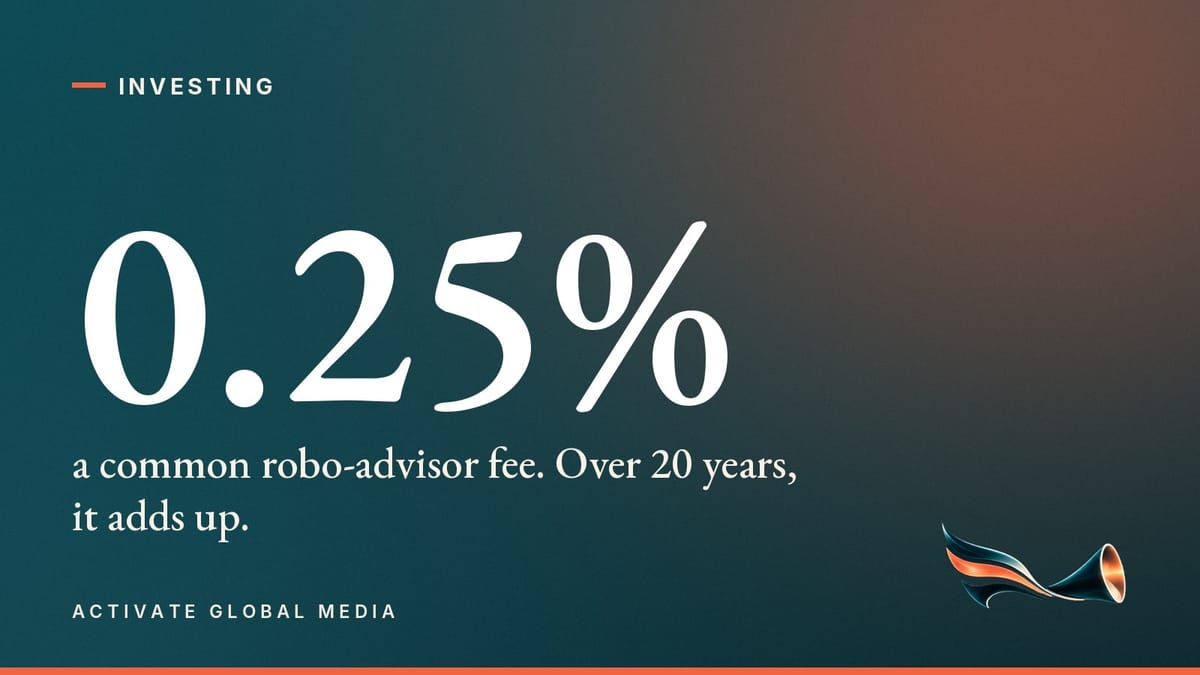
Robo-advisors pick your funds, rebalance and handle tax-loss harvesting on autopilot. Two of the biggest, Betterment and Wealthfront, charge 0.25% a year. That sounds tiny. Over 20 years it isn't.
Why it matters
A fee comes out every year, and money that leaves your account never compounds. On $100,000 growing at an assumed 7% a year, a 0.25% fee leaves you about $17,700 poorer after 20 years than paying nothing. At 0.65%, the gap is about $44,400.
What the big four charge
- Betterment: 0.25% a year once you hold $24,000 or more, or deposit at least $200 a month. Below that, $5 a month. Premium, which adds access to human advisors, is 0.65%.
- Wealthfront: 0.25% a year for its automated investing account.
- Vanguard Digital Advisor: no more than 0.20% a year for its index portfolios, before a credit. Vanguard puts the all-in cost, fund expenses included, at roughly $15 to $16 a year per $10,000. The minimum is $100.
- Schwab Intelligent Portfolios: no advisory fee, with a $5,000 minimum. The trade-off is cash: Schwab's own examples keep 6.9% to 15% of a portfolio in cash, depending on how much risk you choose.
Fund expenses come on top of the advisory fee at Betterment, Wealthfront and Schwab.
On $100,000, in year one
- Betterment or Wealthfront: about $250 in advisory fees, plus fund costs.
- Vanguard Digital Advisor: about $150 to $160, all in.
- Schwab: $0 in advisory fees, but $6,900 to $15,000 held in cash instead of invested, based on Schwab's examples.
The short version
Compare the all-in cost, not the headline fee. Cash held back is a cost too; it just doesn't show up on a statement. Among the big names, 0.25% is the common rate and Vanguard comes in lower.
Fees are from each company's website as of October 11, 2026, and can change. The 20-year figures assume 7% annual growth before fees and are for illustration only. This is information, not investment advice.